Showing posts with label anorexic personality. Show all posts

Tuesday, 6 October 2015

Alcoholic Parent

I certainly do not blame anyone fo my illness but I do believe that having an acoholic mother for the last 10 years has contributed to both my anxiety and anorexia significantly. I found the following article and was shocked to see that I have experienced amost every single 'trait' or feeling that was listed on the page. In fact, I still feel as though my currrent personality is still characterised by all of those things. I suppose the most important this is that I don't allow myself to use these things badly, but insead use them to positively in my life.

My mum has actually stopeed drinking in the last few months whch I am really proud of her for doing. Although it hasn't really changed my life all that much as Ihad moved out anyway, I suppose the reason I am happiest about this is because this will hopefully stop Amy from being hurt as I was, which will hopefully ensure that she never develops an eating disorder or any other illness either. Also, I am glad that my dad no longer has to put up with my mum being drunk all the timme too as she really was awful wheneer she was drinking (which was all the time).

While I am not going to share the entire article with you, as you may not be intereste din it if you do not have an alcoholic parent, I will share with you a list of the typical characteristics of children of alcoholics and also the link to the artilcle (http://www.thisisawar.com/AddictionAlcoholChild.htm). Other traits that were mentioned in he article htat were not included in the following list which I could relate too were always beinng very sensible, finding it difficult to have fun and being approval seeking. The article even said that 'anorexia and bulimia are also common amongst cildren of alcoholics.' which I found very interesting. 

Further characteristics:


1. We became isolated and afraid of people and authority figures;

2. We became approval seekers and lost our own identity in the process;

3. We are frightened by angry people and personal criticism;

4. We either became alcoholics, married them, or found another compulsive personality, such as a workaholic, to fulfill our need for and expectation of abandonment;

5. We live life from the viewpoint of helping and seeking victims, and we are attracted by that weakness in our relationships;

6. We have an overdeveloped sense of responsibility, and it is easier for us to be concerned with others rather than with ourselves;

7. We suffer guilt feelings when we stand up for ourselves; instead, we give in to others;

8. We confuse love with pity and tend to "love" people we can pity and rescue;

9. We have suppressed our feelings from our traumatic childhoods and have lost the ability to feel or to honestly express our feelings. Rationalization seems far easier;

10. We judge ourselves harshly and have a very low sense of self-esteem. We sometimes compensate for this sense of inferiority by trying to appear superior;

11. We are dependent personalities who are terrified of abandonment. We will do anything to hold on to a relationship in order not to experience the pain of abandonment;

12. We became para-alcoholic, taking on the characteristics of alcoholism even though we did not pick up the drink;

13. We became compulsive and obsessive in our behavior;

14. We are unknowingly trying to recreate the chaotic lifestyle with which we are familiar;

15. We are afraid of intimacy and have difficulty forming close intimate relationships;

16. We became aware of feelings which seem to separate us from others, and we find ourselves depressed. Depression is endemic in dysfunctional families

Growing up, I felt incredibely alone when I ad to try and deal with an alcoholic prent by myslef. Please, if you are going through something similar to this and feel as though you need to talk to someone, please feel free to contact me. I would be more then willing to help you through it in any way I possibly can. If you would like to talk to anyone bout this or anything else, my email address is karlygraham94@gmail.com

Tuesday, 30 June 2015

Different types of eating disorders

Whilst my eating disorder was developing, I was mainly in denial about what was happening to me however after a few months of making myself purge after eating particular foods I knew that my behaviours were not healthy or normal. I had cut all unhealthy foods out of my diet however I did not lose very much weight at first, which I think was due to the fact that my body tried to stay at the weight I was at so my metabolism just got slower and slower the less I ate. 
At the time I didn't know much about eating disorders so as soon as I started to think I was suffering from one, I instantly thought it was bulimia as I was making myself sick. Now I can see that it was actually more likely purge type anorexia that I was suffering from, which then changed to restrictive type anorexia when I got fed up with going through the pain associated with making myself sick and not losing very much weight at all. 

It really is surprising just how little weight I lost at first even though I practically halved my calorie intake and started exerising more as well. I would not say that I had food binges in this time, instead I just made mysef sick after eating any foods that I had previously decided I was no longer allowed to eat or if I ate a particularly unhealthy meal. 
When I went to hospital, one psychologist even said that I had EDNOS as I was restricting my intake so severely but was not classified as severely underweight. I do not think that I ever did have EDNOS, I just think that my weight had not yet dropped significantly low because I had not been severely restricting my intake for a long time before my doctor took action and had me admitted.
I know that it really does not matter what type of eating disorder I had at first. Perahaps it was bulimia, or purge type anorexia, heck maybe it was EDNOS? All eating disorders are terrible for the sufferer and life threatening, no matter what they may be called. At the time, I honestly hated making myelf purge more than I hated restricting once my restictive type anorexia developed. 
Making myself vomit is the most awful and painful thing I have ever done. I remember that I just used to cry and cry whilst I was making myself sick because it hurt so much, both mentally and physically. I would not let myself stop until I was convinvced that I no longer had anything left in my stomach. Never think that your eating disorder is not serious because IT IS, no matter what type of eating disorder you have.
No mattter what type of eating disorder you are suffering from, it is important that you try and get better.  No one deserves to live a life with an eating disorder. You desere to live a healthy and happy life that is not regimented or controlled by your weight and food. If you cant get better yourself, please try and get some help from a professional or someone you trust. The following descriptions from this website describe the key differences between different eating disorders.   

Anorexia Nervosa
'Anorexia nervosa' literally means 'loss of appetite for nervous reasons' but this is misleading, as in most cases the appetite of the sufferer is undiminished but is systematically unsatisfied. Individuals with anorexia nervosa are unwilling or unable to maintain a body weight that is normal or expected for their age and height (most clinicians' use 85% of normal weight as a guide). The disorder is characterised by a fear of gaining weight, self-starvation, and a distorted view of body image. Concerns and perceptions about their weight have an extremely powerful influence and impact on their self-evaluation and anorectics typically restrict the amount eaten and drunk, often to a dangerous level. Exercise may be used to burn off what are perceived to be excess calories. The seriousness of the weight loss and its physical effects are minimised or denied

Diagnostic criteria of anorexia nervosa include two subtypes of the disorder that describe two distinct behavioural patterns. Individuals with the Restricting Type maintain their low body weight purely by restricting food intake and increased activity. Those with the Binge-Eating/Purging Type usually restrict their food intake but also regularly engage in binge eating and/or purging behaviours.

Initially the sufferer focuses on food in an attempt to cope with life; it becomes a way of demonstrating control over body weight and shape. Ultimately, however, the disorder itself takes control and the chemical changes in the body affect the brain and distort thinking, making it almost impossible to make rational decisions about food. People who suffer from anorexia often have low self-esteem and a tremendous need to control their surroundings and emotions. As the illness progresses, the sufferer will experience the exhaustion of starvation. Occasionally people die from the effects of anorexia, especially if it is untreated.


Bulimia Nervosa

It was only in 1979 that bulimia nervosa was recognised by doctors as an eating disorder in its own right. The term bulimia nervosa means literally 'the nervous hunger of an ox'. The hunger, however, is really an emotional need that cannot be satisfied by food alone. After binge-eating a large quantity of food to fill the emotional or hunger gap, there is an urge to immediately get rid of the food. Bulimia Nervosa is characterised by these episodes of binge eating (uncontrolled consumption of a large amount of food in a relatively short period of time) followed by an inappropriate "compensation" behaviour such as forced vomiting, laxative or diuretic abuse, a subsequent fast or period of food restriction, or excessive exercising.

Diagnostic criteria for Bulimia Nervosa also identify two sub-types of the disorder: purging and non-purging. Forced vomiting, or abuse of laxatives or diuretics, is considered "purging" whereas fasting or engaging in excessive exercise after a binge to compensate for the calories consumed is considered "non-purging". Sometimes the distinction between bulimia and the binge/purge type of anorexia is difficult to draw. However, if a patient meets all other criteria of anorexia nervosa, that is generally the diagnosis which is made.

Bulimia is more difficult for others to notice as the sufferer tends not to lose weight so dramatically, or their weight will fluctuate. People with bulimia may have demanding jobs that require them to be out-going and self-assured even when they feel inadequate inside. As with anorexia, people who develop bulimia become reliant on the control of food and eating as a way of coping with emotional difficulties in their life. During the binge episode, the individual experiences a loss of control. However, the sense of a loss of control is also followed by a short-lived calmness. The calmness is often followed by self-loathing. The cycle of overeating and purging usually becomes an obsession and is repeated often.

Eating Disorder Not Otherwise Specified (EDNOS)

Eating disorder not otherwise specified (EDNOS) is a diagnostic category of mental disorders that involve disordered eating patterns. It is described in the diagnostic manuals as a "category [of] disorders of eating that do not meet the criteria for any specific Eating Disorder". A diagnosis of EDNOS is frequently used for people who meet some, but not all, of the diagnostic criteria for anorexia nervosa or bulimia nervosa. For example, a person who shows almost all of the symptoms of anorexia nervosa, but who still has a normal menstrual cycle and/or body mass index, can be diagnosed with EDNOS. A sufferer may experience episodes of binging and purging, but may not do so frequently enough to warrant a diagnosis of bulimia nervosa. A person may also engage in binging episodes without the use of inappropriate compensatory behaviours; this is referred to as binge eating disorder. People diagnosed with EDNOS may frequently switch between different eating disorders, or may with time fit all diagnostic criteria for anorexia or bulimia.

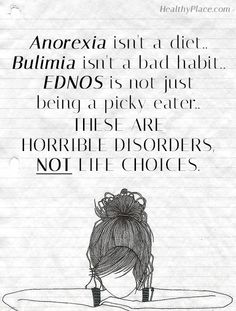
EDNOS is a serious eating disorder, like anorexia and bulimia, with various subtypes (such as Binge Eating Disorder, Compulsive Overeating and Orthorexia Nervosa, as described below) and can have long-term consequences on the individual's physical health.


Binge Eating Disorder (BED)

Binge eating disorder is characterised by consuming large quantities of food in a very short period of time until the individual is uncomfortably full. It is similar to the eating disorder bulimia nervosa except the individuals do not use any form of purging following a binge. Additionally, people with bulimia are typically of normal weight or may be slightly overweight whereas people with binge eating disorder are typically overweight or obese. Individuals usually feel out of control during a binge episode, followed by feelings of guilt and shame. Many individuals who suffer with binge eating disorder use food as a way to cope with or block out feelings and emotions they do not want to feel. Individuals can also use food as a way to numb themselves, to cope with daily life stressors, to provide comfort or fill a void they feel within. Like all eating disorders, binge eating is a serious problem but can be overcome through proper treatment.

Binge eating disorder is similar to, but it is distinct from, compulsive eating. People with binge eating disorder do not have a compulsion to overeat and do not spend a great deal of time fantasising about food. On the contrary, some people with binge eating disorder have very negative feelings about food. As with other eating disorders, binge eating is an expressive disorder - that is, the disorder is an expression of a deeper, psychological problem.

Continual debate exists over whether binge eating disorder should have its own diagnosis. Some believe that it is a milder form, or subset of bulimia nervosa, but others argue that it is its own distinct disorder. Currently it is characterised under Eating Disorder Not Otherwise Specified (EDNOS), and the diagnostic manual simply states that ‘more research is needed’.


Compulsive Overeating

Compulsive overeating is characterised by an addiction to food. An individual suffering from compulsive overeating disorder engages in frequent episodes of uncontrolled eating, or binging, during which they may feel frenzied or out of control. They will eat much more quickly than is normal, and continue to eat even past the point of being uncomfortably full. Binging in this way is generally followed by a period of intense guilt feelings and depression. Unlike individuals with bulimia, compulsive overeaters do not attempt to compensate for their binging with purging behaviours such as fasting, laxative use or vomiting. Compulsive overeaters will typically eat when they are not hungry, spend excessive amounts of time and thought devoted to food, and secretly plan or fantasize about eating alone.

In addition to binge eating, compulsive overeaters can also engage in grazing behaviour, during which they return to pick at food over and over throughout the day. This will result in a large overall number of calories consumed even if the quantities eaten at any one time may be small. When a compulsive eater overeats primarily through binging, he or she can be said to have binge eating disorder. Where there is continuous overeating but no binging, then the sufferer has compulsive overeating disorder. Compulsive overeating almost always leads to weight gain and obesity, but not everyone who is obese is also a compulsive overeater.

Compulsive overeating is a maladaptive behaviour that may be used as a way to cope with stress, emotional conflicts and daily problems. Food is used to block out feelings and emotions. Excessive weight may act as a shield they can hide behind to avoid social interaction. Sufferers usually feel out of control and are aware their eating patterns are abnormal. Like bulimics, compulsive overeaters do recognise they have a problem. Compulsive overeating is a serious condition and needs professional support to ensure long-term recovery.


Orthorexia Nervosa

People who eat a normal amount of food, but become exceedingly obsessed with healthy eating, or strictly categorize normal foods or entire food groups as "safe" and "off-limits", may be referred to as having orthorexia. Orthorexia Nervosa is an obsession with a "pure" diet, where it interferes with a person's life. It becomes a way of life filled with chronic concern for the quality of food being consumed. When the person suffering with Orthorexia Nervosa slips up from wavering from their "perfect" diet, they may resort to extreme acts of further self-discipline including even stricter regimens and fasting.

"This transference of all of life's values into the act of eating makes orthorexia a true disorder. In this essential characteristic, orthorexia bears many similarities to the two well-known eating disorders anorexia and bulimia. Where the bulimic and anorexic focus on the quantity of food, the orthorexic fixates on its quality. All three give food an excessive place in the scheme of life." (Steven Bratman, M.D., October 1997). Although the word is entering the English lexicon, the psychiatric community has not officially recognized the condition.

You can also read the symptoms of each eating disorder here

Sunday, 10 May 2015

More about me

After asking what it was that everybody wanted me to write about, someone kindly suggested that I publish more personal posts so that everyone can get to know me and my personality more. So every few days I plan to write a post that will help you all get to know more about me. I can see why you want to know more about me, as this allows you to better undertand everything else I write.

I suppose the reason I havent written many posts like this is the past is because im still not very good at being the centre of attention if that makes sense. I have always put others first and find it hard to believe that anyone would want to read about me and my life. But I promise I will try to start doing more of this now. Afterall, while I like to try and help others through my blog, my blogging also needs to be about me. I need to think of  my own recovery as my first priority and helping others as an added bonus.

Writing these types of posts will be a good exercise for me as it will show me that it is ok to put myself first and share my personality with others. Even now as I am trying to think of ideas, nearly everything that comes to mind, I find myself disregarding as I believe readers just wont want to hear about me. Thats what blogging is about though. If you didnt want to read about me, I guess you wouldnt be reading my blog in the first place.

So I am sorry if my personality has been lacking a little in past posts, it is literally just due to my poor self confidence. Thank you all for continuing to read my blog each day even though I know its not perfect. I am still new to blogging and am still learning what works and what doesnt so please, I appreciate all the constructive critisism I can get and will never take it offensively.


Writing about myself and my personality wont be easy for me so if any one has any particular questions or post themes they want me to write about please help me get the ball rolling and comment them for me to see. :)

Saturday, 2 May 2015

Similarities between sufferers

Something I have always found pretty unbelievable since becoming ill is how similar people with anorexia can be in their personalities as well as there behaviors. I find it amazing that I can have the exact same habits or rituals as other anorexics who live on the other side of the world who I have never met. How is it that we started practicing the exact same rituals? It is almost as if it is somehow 'programmed into our illness.'

I have many Personality traits that are common amongst other anorexia sufferers. My whole life I have been a perfectionist and an over achiever. I  compared myself to other people while I was growing up a lot and would feel disappointed in myself if I thought I wasn't as good as somone else. I have always been a very anxious and sensitive person which made me doubt myself and constantly worry that I was doing something wrong. I cared way too much about what others thought about me and was always paranoid people were judging me.


The following article taken from here explains a bit more about these personality traits;

The Personality traits such as neuroticism (emotional stability), obsessiveness, and perfectionism play a large role in facilitating some eating disorders, particularly anorexia and bulimia. Research suggests that these traits are at least partially driven by genetics. Individuals with these personality features are predisposed to be anxious, depressed, perfectionistic and self-critical; all factors that may contribute to their difficulty managing weight and eating in a healthy manner.


Individuals with anorexia and bulimia tend to be quite competitive, and are quite driven to succeed. They tend to compare their appearance and accomplishments against unrealistic standards and typically find themselves lacking. Most of these judgments involve culturally-derived or peer-sanctioned standards rather than personal expectations. In other words, people with eating disorders are primarily concerned about what others think of them, rather than what they think of themselves. Other people with eating disorders, such as athletes, tend to judge themselves against internally derived standards, and get upset when they fail to live up to their own ideals, expectations and goals.
Regardless of what set of standards they judge themselves against, perfectionists always strive to meet the highest standard of performance possible. They easily find themselves in a self-defeating cycle of fear and dissatisfaction when they fail to meet their expectations and goals, even when such expectations are unrealistic and unhealthy. This sense of fear and dissatisfaction is exactly the fuel and motivation that perpetuates a renewed drive toward thinness, perfection, and control. Hence, the endless cycle of dysfunctional eating behavior that constitutes eating disorders.
A capacity for obsessive thinking tends to accompany perfectionism with regard to eating disorders, particularly with anorexics. Anorexic individuals become hyper-focused or obsessed with food and with the idea of controlling their eating so as to become thin. Other elements of extreme thinking may be observed as well, notably a tendency towards rigid "black and white" (for example, I am either perfect or terrible) thinking. Because of their mental inflexibility, anorexic individuals may be unwilling or unable to acknowledge that their behaviors are out of control and that there are alternative ways to become happy besides weight loss. They perceive any deviation from their self-imposed weight-loss regime as an unacceptable failure. As a result, they may have great difficulty accepting suggestions or advice from others, even from those they know to be well-meaning. People with eating disorders may experience such supportive attempts as evidence that others don’t really understand them.
There are various behaviors and rituals that I adopted whilst suffering from anorexia that I was surprised to read that other anorexics also practiced whilst sick. Meals had to be eaten under perfect conditions. I preffered to be alone and I had to eat at the right time of day. Eating before my normal meal time made me feel weak as it would mean giving into the temptation of hunger. I became very specific when selecting my crockery and cutlery. I would eat everything with a teaspoon, child sized fork and knife so that it would take me longer to finish my meal. Early on in my illness I always cut my food into tiny pieces and ate tiny mouthfuls of food at a time but since starting to eat more, this behavior has subsided. I would choose the smallest bowl or plate that my food could fit into so I felt as though I was eating more than I actually was.

I prepared all my food by myself and was too frightened to leave my food unnattended as I was scared someone would tamper with it. I liked watching tv while I ate my meals and would even stop eating in ad breaks for some bizarre reason. I always needed to have a glass or bottle of water with me while I was eating a meal and my food had to be nice and hot and well prepared. I kept all of my food in my bedroom so no one else would touch it and prepared some meals inside my bedroom. I would instantly become very defensive if anyone ever questioned me about my behavior or my food. I cooked alot for my family but never tried anything I baked for them as I couldnt be sure of the calories it contained. I had to know the exact number of calories in everything I ate so obsessively weighed and measured out everything.


It is important to remember that although there are some similarities between sufferers, no two cases of anorexia are identicle and that there will always be some differences. You should never feel as though you are expected to act a certain way because you are anorexic. Dont feel as though something is wrong with you or that you arent really sick because you dont have a specific anorexic behavior or because you have a symptom that is not very common. Everyones illnesses will vary and recovery journeys will also be very different for everyone.

While it is common for anorexics to leave food in the bottom of food containers or on your plate I have never done this. In fact, I have always eaten the entirety of what I had told myself I was allowed to eat before starting a meal. It is a habit of mine to scrape bowls and plates until they are completely clean and it doesnt matter how full I am, I will always finish every single meal. I also never skip meals which I know other anorexics commonly do. I think that this is because I love food so much and therefore once I decide what I am going to eat I have in a way given my self permission to eat that meal. As long as my meal fitted into my daily calorie allowance at that time, while I ate it I felt reasonabely comfortable and didnt feel the need to leave any as I knew I wasnt eating too much. Has anyone else felt this way about food throughout their illness?

Another weird Anorexic behaviour of mine that I am not sure if anyone else has experienced is to do with how I chew. I have always chewed the exact same amount of food on the left and right sides of my mouth. For example if I was eating cereal, I would get a cereal flake and chew it on the left side of my mouth before picking a flake the same shape and size and chewing it on the right side. Or while eating something like vegetables I would chew 1 piece of carrot on the left for every one piece of carrot the right. If I was left with only one piece of something, for example one grape, I would bite it in half so I can chew half of it on my left side and then half on my right.


I know it sounds crazy but I cant explain why I do his. It has gotten a lot worse since having anorexia but I even remember doing it before I had anorexia with specific foods like rice crackers as well as colorful foods like fruit loops. I think that it is possibely OCD? Has anyone else ever done anything like this?