Monday, 20 March 2017

The Long-Term Effect Of Eating Disorders That Nobody Talks About

I found the following article really interesting and thought it may interest some of my readers as well. All of my organs became very weak when I was unwell (particularly my hear) and I often wonder about whether or not those organs have repaired fully yet or not.

This is why I think it so important to continuing nourishing your body, even after you become weight restored as a lot of the damage that you do to your body during starvation may not be reversed even when you are weight restored.

The Long-Term Effect Of Eating Disorders That Nobody Talks About                  


With Healthy Heart Month in full swing, you might be hearing advice everywhere from your family doctor to your favorite newsletter about what to cut out of your diet to keep your heart strong. Ditch the soda! Cut the carbs! Skip the butter! Oh, wait, butter's back in! But maybe olive oil is better?!
While most of us can take this influx of diet advice in stride, those at risk for eating disorders are vulnerable to this deluge of information. In many cases, the eating patterns that eventually precipitated a full-blown eating disorder started with the intention to be healthier and feel better—both physically and emotionally. In a sadly ironic twist, those behaviors have likely contributed to the serious decline in health often associated with eating disorders.

Eating disorders are more than just a psychiatric illness.

In fact, eating disorders have the highest mortality rate of any psychiatric illness (or behavioral health disorder). So not only do they lead to a host of social, mental, and physical problems, but they actually put someone at increased risk for other health problems. Cardiovascular complications are one of the biggest risks for those struggling with eating disorders. The heart is made of muscle and basically functions as a pump that moves blood first to the lungs to pick up oxygen and then out to the extremities to bring oxygen and nutrients throughout the whole body. Our hearts are clearly key to our ability to live and function normally, and eating disorders put strain on the heart in a number of ways.

1. Weaker heart muscles

First, when one does not take in enough food to support our level of activity, the heart rate slows down as the body tries to conserve energy. Also, blood pressure will drop due to dehydration or because the muscles of the heart weaken. When blood pressure is low, it's harder for other organs—like the kidneys, the brain, or the liver—to receive the nutrients and oxygen that the heart usually pumps in their direction.
People with low-weight eating disorders actually lose cardiac muscle mass. All muscles of the body are subject to wasting away if we aren't nourishing them. Heart muscle is no exception. Underweight patients may develop mitral valve prolapse due to shrunken heart muscle cells, or they can develop heart failure due to a weakened heart that can't pump well.
ADVERTISEMENT

2. Shifts in the heart's chemical environment

A second concern is the development of abnormal heart rhythms, which happens frequently when someone is suffering from bulimia nervosa. The behaviors of binge eating and purging (which can involve not just vomiting but also laxative and diuretic use), can lead to dehydration and dangerous shifts in electrolytes in the body. When the chemical environment of the heart is abnormal, the heart is at risk for arrhythmias, which can cause heart palpitations, fainting, and even death.

3. Cardiac disturbances

And thirdly, there are a host of cardiac rhythm disturbances that are directly caused by weight loss and malnutrition. These are undoubtedly causal in the heightened risk for sudden death seen in people with anorexia nervosa.
Despite these very serious cardiac concerns, many people with eating disorders are reluctant to get help. The disorders themselves are marked by a brain-based type of denial that can make even seeing that there's a problem very difficult. As a clinician, I find that sometimes the presence of these heart issues can help someone see just how high the risk to their health really is.

Healing your body from an eating disorder

But even those who begin the process of recovery have to be very cautious about their heart health. For someone who has been eating very little, starting to eat more can cause its own dangerous shifts in electrolytes called refeeding syndrome, which again puts the person at risk for cardiac complications. Thus, some patients will need to be very closely monitored by a medical team during this process.
The heartening news is that most of physical complications of eating disorders are reversible with good nutrition. Once the body and mind are recovered and a knowledgeable support team is in place, the person has a great chance of living a long, healthy life.

If you've suffered from an eating disorder, keep the following in mind:
  1. Take any cardiac event very seriously. If you experience any chest pain, are getting dizzy when you stand, have a fainting episode, or notice your heart rhythm seems off, get to a medical provider as soon as you can.
  2. Enlist the support of others. We know that eating disorders thrive in isolation, and recovery thrives in community with others you care about. Let someone close to you know that you're worried about your health.
  3. Know that recovery is always possible. Even people who lived with an eating disorder for a very long time can expect a full and lasting recovery. It's not easy and can't be accomplished alone, but EVERYONE suffering from an eating disorder can be helped.
The recently deceased George Michael once said, "You'll never find peace of mind until you listen to your heart." Listen carefully to the messages your heart is sending you. And with the right treatment, you can find peace from the burden of eating disorders.
For additional information about the Eating Recovery Center, call 877-789-5758, email info@eatingrecoverycenter.com, or visit www.eatingrecoverycenter.com to speak with a master's-level clinician.

Wednesday, 1 March 2017

Weight gain is not negotiable if you want to recover

In order to recover from a restrictive eating disorder, you WILL NEED to gain weight (especially if you are currently underweight). As much as we would like this to be untrue, if you are not willing to gain weight, you will not recover as this just shows how unhealthy your mindset is. It is only when you challenge and overcome this type of unhealthy mindset, that you will be able to continue making recovery progress and actually make a full recovery. As well as needing to reach and possibly exceed a healthy weight in order to recover mentally, you need to do this is order to recover physically too. Whilst starving yourself, your body weakens and stops functioning as it should in order to conserve energy. Your energy reserves run dangerously low and all of your internal organs and bones are at risk of severe damage also. The following article explains the toll that anorexia or other restrictive eating disorders have on your body due to starvation. 

(http://www.webmd.com/mental-health/eating-disorders/anorexia-nervosa/features/anorexia-body-neglected#3)


What happens exactly? Here's a look at what anorexia does to the human body.

The first victim of anorexia is often the bones. The disease usually develops in adolescence -- right at the time when young people are supposed to be putting down the critical bone mass that will sustain them through adulthood.

"There's a narrow window of time to accrue bone mass to last a lifetime," says Diane Mickley, MD, co-president of the National Eating Disorders Association and the founder and director of the Wilkins Center for Eating Disorders in Greenwich, Conn. "You're supposed to be pouring in bone, and you're losing it instead." Such bone loss can set in as soon as six months after anorexic behavior begins, and is one of the most irreversible complications of the disease.

But the most life-threatening damage is usually the havoc wreaked on the heart. As the body loses muscle mass, it loses heart muscle at a preferential rate -- so the heart gets smaller and weaker. "It gets worse at increasing your circulation in response to exercise, and your pulse and your blood pressure get lower," says Mickley. "The cardiac tolls are acute and significant, and set in quickly." Heart damage, which ultimately killed singer Karen Carpenter, is the most common reason for hospitalization in most people with anorexia.

Although the heart and the bones often take the brunt of the damage, anorexia is a multisystem disease. Virtually no part of the body escapes its effects. About half of all anorexics have low white-blood-cell counts, and about a third are anemic. Both conditions can lower the immune system's resistance to disease, leaving a person vulnerable to infections.
Anorexia Damage Starts Early

Even before a person with anorexia starts to look "too thin," these medical consequences have begun Many young women who begin eating a severely restricted diet stop menstruating well before serious weight loss sets in. Since so many people with anorexia are teenage girls and young women, this can have long-term consequences on their ability to bear children.


Gaining weight will allow your body to function more optimally again and to reverse most of, if not all of the damage you inflicted on it whilst your were starving yourself. Even if you manage to partially recover mentally so that you can live like a relatively normal person, if you are still underweight your body will not be able to function properly. The chances of you conceiving a baby are reduced if ever you want to become a mum and you are more likely suffer from illnesses or infections as your immune system will not be as strong as somebody who is a healthy weight. Also if you are underweight, this indicates that you are still not eating enough  (as otherwise your body would return to a healthy weight) which suggests you are probably missing out on particular nutrients and minerals that your body requires. This puts you at risk of things like Anemia (due to lack of iron) and osteoporosis (due to lack of calcium).

In my experience, I was not able to make any real recovery progress until I gained a significant amount of weight. The hard thing about gaining this weight is that you need to do it when your anorexic thoughts are still incredibly strong and overpowering. It isn't until you get closer and closer to a healthy weight that these thoughts begin to fade and are replaced with healthier'and more normal thoughts. There is no real secrets or techniques to making these thoughts go away. As hard as it is, you just have to push through them and remember that by fighting these thoughts you ARE getting closer to having the life you want and deserve. I suggest trying to stay busy so that you have other things to focus on and just have faith that if you continue fighting your anorexic thoughts, in time they will fade. And how do you gain weight? You basically just do the complete opposite of everything your anorexia tells you to do. You limit or stop your physical activity, you eat more then you ever have in your life and you stop doing all of those destructive things that you have done in the past.

I remember some nights my thoughts would be so strong (in regards to the fear of and actually gaining weight) that I just had to go to bed and cry myself to sleep. But I never gave into my anorexia and always just woke up the following day and ate everything on my meal plan, limited my exercise and went against everything my anorexia told me to do. I knew that I couldn't give into my anorexia by listening to its demands as this would be like giving it ammunition it needed to beat me. Once I gave into my anorexia once, I knew it would be so easy to continue giving into it and this would not allow my thought processes to change. So I stuck to my guns and consistently beat my anorexia and that is how I got to where I am today. So no matter how hard it may seem, just remember that it is possible and you can do it. No matter how loudly your anorexia screams at you and how bad it makes you feel, it cant actually hurt you. That pain is just temporary. And by enduring that pain now, you will be able to have a lifetime of happiness in the future.

I know that gaining weight as slowly as possible seems like the best way to gain weight to someone with anorexia but from my own experience I do not think this is the best thing to do. To be honest, gaining weight incredibly slowly just draws out the painful process of weight restoration and means that you are just inflicting extra suffrage on yourself. I was gaining about 500-700g per week when I was actively recovering and I found that this was a good rate to do it at. I feel it was a good rate of weight gain as I could adjust to my physical changes without relapsing while still keeping a good momentum. Gaining weight at this rate also made it obvious to me whenever I needed to increase my calories (due to my weight gain stopping). If I was gaining less then this per week, I think I would have been more likely to just brush off failure to gain weight in any particular week which would have stopped me from moving towards my goal of complete weight restoration and recovery. 

I believe that gaining weight is not the only thing you need to do in order to recover, in fact it is only the beginning. But it is one of the first essential things for you to do before you can make any other type of real recovery progress. So I highly encourage you to start doing it as soon as possible. As you do manage to gain weight, your body will start functioning properly again and you will also start thinking more clearly too. And I know it probably feels like accepting your body at a higher weight is impossible but I promise you its not. I am currently about 15 kg heavier than my lowest weight (which I couldn't bare to leave at the time) and I love my body more now then I ever have before!  The truth is you will never feel ready to start gaining weight so you just need to make the decision and start. I promise you it will be worth it!


Monday, 27 February 2017

Home to Swansea

After not being home to see my family since christmas, I really enjoyed travelling home to Swansea for the weekend with my boyfriend. Things have not been great for my family over the last few months and even though the issues are still ongoing, it was still nice to go home and see everyone. Now that I have my own life in Launceston, it would be so easy to just completely distance myself from my family and all their problems back in Swansea but that wouldnt be fair on my little sister and dad. I love them so much and want to be there for them to help them through any difficulties they may face. So my boyfriend and I started the 1.5 hour drive to Swansea when he finished work on Friday afternoon and we arrived at my family home at about 6:30pm. Unfortunately my dad was away for the weekend but it was still great to see my sister. My sister Amy has been my best friend for as long as I can remember and despite the 6 year age gap between us, we get along incredibely well. 

On Saturday morning my mum and I went for a walk on our farm and had a very close encounter with a 6 foot long tiger snake. By the time we saw the snake, we were only a single step away from it and it obviously felt threatened by us as it reared its head and striked at us. Luckily we both jumped back at that exact moment so the snakes head (and fangs) just missed us. If the snake had tried to bite us a second time it would have bitten one of us for sure as we were simply too close and couldnt get away. Thank goodness it decided to slither off instead leaving us full if adrenalin but unharmed. We then drove into Swansea to visit my nan before meeting my herbalife coach Phoebe for lunch. I had my all time favourite meal (which I hadnt had for ages) caeser salad and it was so yummy! We then visited my other nan and went out for tea with my mum. For tea I had Spaghetti bolognaise with a side of vegetables which was ok but not as nice as lunch. I loooove pasta but prefer tomato or chicken based pastas, rather then mince. I still ate it all though, to everyone elses surprise as it was huuuuge! 

I took my mum home after tea but then went back into town with my boyfriend Nathan. I wasnt drinking alcohol like I usually do when we go out in Swansea as I had to drive home but my boyfriend was and we had heaps of fun playing 8 ball (pool). We also chatted with my uncle, aunt and cousin for an hour or two which was really nice. When we got home that night my brother Luke was there so it was really nice to see him. The following morning nathan, Amy and I headed into Swansea with two of our puppies to go for a nice walk on the beach. We had running races on the beach and just enjoyed the sunshine and scenery. We started the drive back to Launceston at about 2pm and were back home by about 4. Overall it was a really nice weekend and I am looking forward to heading back to Swansea one weekend soon, but when my dad is home so we can spend some time with him too.

This is the type of snake we ran into 


My gorgeous sister and myself


My boyfriend nathan and me

Nathan, cassie the puppy and me


Friday, 17 February 2017

What I eat in a day

I thought it would be a good idea to share with you all what I eat on a typical day now that I am recovered. I don't eat exactly the same amount of calories every day but I know about what I eat and I never eat any less then 2200 calories. I eat relatively healithily, not because I am scared of typically unhealthy foods, but because I enjoy healthy foods as well as nourishing my body. I find I feel much more energetic and happy when I eat nutrient rich foods so thats why I chose to eat them most of the time. I thought I would share with you what I haveveaten over the last 3 days, so that you can get a good idea of what I usually eat :)

Tuesday
Meal 1: 1 large bowl of raspberry oats (equivalent to 2 typical portions) made with half a cup of soy milk, 1 cup if water and 1 scoop of protein powder

Meal 2: 1 vanilla and banana shake made with 1 banana, 250mL soy milk, 2 scoops of herbalife vanilla sport f1 shake mix and 8 ice cubes

Meal 3: 3 rice cakes topped with tomato and cheese, 3 rice cakes topped with egg (1 boiled egg mixed with mayo), 1 apple, 1 strawberry Chobani greek yoghurt

Meal 4: 1 herbalife protein bar and 1 banana

Meal 5: went out for dinner and ordered chicken schnitzel with gravy and vegetables

Meal 6: 1 yoplait forme yoghurt and 1 peach

Wednesday

Meal 1: 1 large bowl of oats (equivalent to 2 typical portions) made with half a cup of soy milk, 1 cup if water and 1 scoop of protein powder with 1 diced pear

Meal 2: 1 herbalife chocolate shake made with 1 scoop of dutch chocolate f1, 1 scoop if creamy vanilla sport f1 and 300mL almond milk

Meal 3: vegetable lasagna and salad (lettuce leaf mix, diced beetroot, cherry tomatoes, fetta cheese, olive oil)

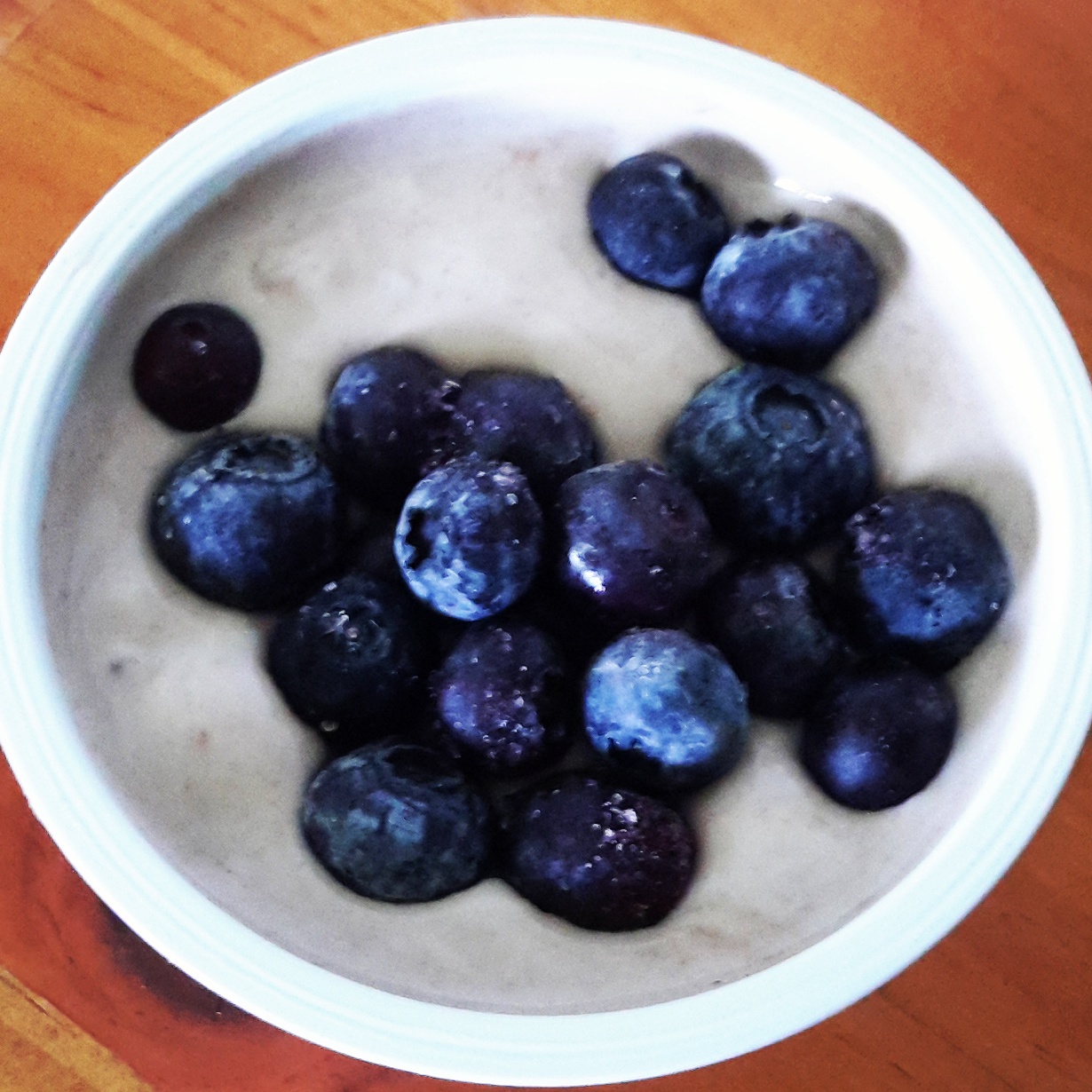
Meal 4: 1 tub of chobani plain greek yoghurt mixed with 1 scoop of herbalife chocolate rebuild and blueberries (picture below)

Meal 5: 3 scrambled eggs cooked with 1 diced tomato and 60g of feta cheese with vegetables (baby broccoli, beans, pumpkin and carrot)

Meal 6: herbalife protein bar, watermelon and salt and vinegar rice wheels

Thursday
Meal 1: 1 chocolate and banana shake made with 1 banana, 250mL soy milk, 2 scoops of herbalife f1 dutch chocolate shake mix and 8 ice cubes

Meal 2: 1 large bowl of oats (equivalent to 2 typical portions) made with half a cup of soy milk, 1 cup if milk and 1 scoop of protein powder

Meal 3: 3 rice cakes topped with tomato and cheese, 3 rice cakes topped with egg (1 boiled egg mixed with mayo), 1 yoplait forme berry yoghurt, watermelon and 2 pieces of herbalife chocolate

Meal 4: 1 small packet of salted popcorn, 1 protein  bar and grapes

Meal 5: honey soy chicken stirfry with hokkien noodles and vegetables (broccoli, carrot, beans)

Meal 6: Herbalife mug cake made with 2 scoops of chocolate f1 mix, 1 scoop of protein powder, 1 egg and 1/4 cup of milk microwaved and topped with greek yoghurt


Throughout the day I also snack on little things spontaeously like herbalife chocolate, grapes, rice cakes etc as I am walking through the kitchen (i.e. I have eaten 14 pieces of herbalife chocolate (which is actually higher calorie then normal chocolate) over the last 4 days. I drink atleast 2.5 litres of water per day which I add herbalife products to like Aloe, herbal tea, active fibre complex, hydrate or drive. I also take quite a few supplements as part of my nutrition program (i.e. 3 multivitamins, 3 cell-U-loss, 2 joint support, 1 chitosan fibre, 1 probiotic, 2 NRG's).

I currently have the best relationship with food I have ever had and I couldnt be happier. I no longer take anti anxiety medication and just feel so wonderful everyday, knowing that I am fueling my body with delicious and nutricious foods. In order to recover, you need to have a good relationship with food and you must be able to trust your body to tell you what it needs. Food is not something you should ever be scaredbof, it is simple fuel for your body and something that should be enjoyed. If you have any questions about my intake, feel free to leave a comment below.


What recovery means to me


In my opinion, this is only the very start of what recovey means to me. Overall, recovery simply means getting your life back. But after recovery I believe life is even more beautiful and incredible as you appreciate evey moment, instead of taking it for granted like most people do. You will see in the following photos that I am incredibly happy in evey single one. And I promise you that this smile was not just put on for the photos, this is how happy I am all of the time. People ask me how I can be so happy, bubbly and friendly all the time and I just tell them that it is completely effortless for me. I act this way because I am just so truly thankful and blessed for my health and all of the incredible things I have in my life.


Sunday, 12 February 2017

FEELING UNCOMFORTABLE WITH YOUR GROWING BODY? TRY THESE 4 MINDSET SHIFTS

I found this article and wanted to share it with you all. I think it has some wonderful advice for anyone in recovery... xox


BY STEPHANIE KIRSCHNER BODY
JANUARY 18, 2017l
I feel it when I wake up in the morning and try on every single pair of my jeans and everything looks bad and I just want to go back to sleep. But my secret is: even though I wish I could be thin, and that I could have the ease of lifestyle that I associate with being thin, I don’t wish for it with all of my heart. Because my heart is reserved for way more important things. –Mindy Kaling
Though my road to recovery has been marked by various victories, I still have days when my growing body upsets me. This usually happens when I can’t pull an old dress down past my waist, or when a pair of my jeans fits so tightly that I experience intense anger any time I wear them.


Sometimes after these wardrobe failures, I start genuinely buying into the idea that I must begin exercising constantly and sticking to a strict diet of baby carrots and salsa if I expect to have a hope in this world. I begin my frenzied Google tirade, searching such intellectual topics as “how to lose weight in your hips but keep it in your chest”, “why are my hips still growing even though I’m an adult woman?”, and “why are my jeggings so ridiculously tight today?”


But the truth is, even when you know deep down that you are on a trajectory toward health, it can be tough to silence the sneaky voices attempting to convince you otherwise


Of course, I feel like a fool after these escapades, mostly because I know I should be Googling “volunteer opportunities near me”, “how to save the world”, and “Mother’s Day gift ideas” instead. But the truth is, even when you know deep down that you are on a trajectory toward health, it can be tough to silence the sneaky voices attempting to convince you otherwise.


How can you be getting healthier when you’re getting heavier? Why are you trying to convince yourself that buying bigger clothes is a positive thing? Doesn’t that just mean that you lack discipline and self-control?


Embracing your recovery journey can be challenging, especially when you’ve been indoctrinated to believe that gaining weight or increasing in size are undesirable and shameful. For many of us, embracing the journey requires a complete shift in mindset. It requires moment-by-moment choices to surrender to the process and to continually extend grace to yourself.


Embracing your recovery journey can be challenging, especially when you’ve been indoctrinated to believe that gaining weight or increasing in size are undesirable and shameful


It requires that you relinquish shame and comparison and self-loathing. It requires daily self-acceptance and self-love. Embracing the journey, in short, likely requires of you that which, for however long, you have attempted to stifle and suppress.
And a journey like that is bound to have its ups and downs.


Some days I love my new curves, and some days I miss my protruding hipbones. Some days I can’t wait to eat, and some days I miss the time when I didn’t. Some days I feel confident in my recovering body, and some days I miss the security of my sick one.


As twisted as it may sound, I can tend to idealize and romanticize the era of my eating disorder. That place of frailty and starvation had become so seemingly safe and comfortable. But when I take the time to thoroughly reflect on those years, I realize that there was something dead in me that is now being nourished and tended to and cared for.


…when I take the time to thoroughly reflect on those years, I realize that there was something dead in me that is now being nourished and tended to and cared for


And that is what embracing recovery is all about—


realizing that your growing body is not a sign of failure, but rather a testament of victory in the courageous fight for your life. How exciting is that?


Here are four simple reminders to aid in learning to embrace your journey and all that comes along with it:
One:


You do not need to explain or justify the way your body changes, the weight you gain, or your personal choices regarding recovery to anyone else, especially to those sneaky lying voices.
Two:


Gaining weight ≠ losing value as a human being, despite what the magazines declare, despite what certain men allegedly prefer, and despite what we may sometimes resort to believing. Remember: growth = good.
Three:


Surrounding yourself with kind and hopeful people who support your recovery journey and promote your recovering body is key to success.
Four:


Some days are bound to be more difficult than other days, but this does not negate that which you know to be true. You will fall down once in a while, and that is okay. The important thing is that you remember that you do have the strength to get back up, and that you do have the authority to declare truth and freedom in this area of your life.


The important thing is that you remember that you do have the strength to get back up, and that you do have the authority to declare truth and freedom in this area of your life.

Tuesday, 7 February 2017

Just a little update

I know that this post is well over due and for that I apologise. I was hoping that when I completed university last semester I would have more time for blogging but sadly that has not been the case at all. Life has been super busy and I am a little worried about how hectic things will be when I return to uni for my next semester. Part of me is excited to get back into studying again as I truly do love learning, especially about health science however another part of me is feeling a little lazy about going back to studying. I am confident however that I will be able to keep a happy and balanced lifestyle again this year, as I was able to do last year. I was so proud of my results for my last semester of study and even prouder that I was able to stay so healthy and happy while achieving those results, unlike at times in the past when I was unable to do this.

Outside of study and work, things are still great for me. Things are as wonderful as ever between my gorgeous boyfriend Nathan and myself and I am still feeling fantastic on my Herbalife Nutrition program. I feel as though my relationship with food is still wonderful and I am able to just enjoy everyday the way all people should be able to, with no added anxiety, fear or stress. Life is simply good! I exercise most days, either at the gym or by going for a walk with a friend and I love feeling so fit and healthy. Something I have found since being on my Herbalife nutrition program is that my immune system is incredible. I cant remember the last time I was sick and even when those around me get colds or illnesses, I never seem to get them. I guess this just goes to show how healthy my body really is now, as it manages to fight off any viruses before I actually start experiencing any symptoms.

My weight is stable and I do not feel as though I have to try really hard to keep it that way. I just listen to my body and it tells me if I need to eat more to make up for any extra physical activity I may do. I know approximately how many calories I eat each day (lets be honest, its difficult not to know how much we eat in terms of calories as post anorexics) but eating more or less doesn't scare me. Of course I try not to eat less then my usual amount most days but occasionally due to lack of appetite or hectic work hours I will eat slightly less. Just as I sometimes eat more if I have a weekend away or am extra Hungary. Neither of which scare me anymore which feels great. I know that this wont affect my weight and that this is just how normal people live!

Nathan and me (far left) with our gang at the Adelaide Herbalife Spectacular Party

Nathan and I (taken out with friends in Hobart) 

Since starting Herbalife and making a full recovery from anorexia, I feel the healthiest and happiest I ever have in my life!